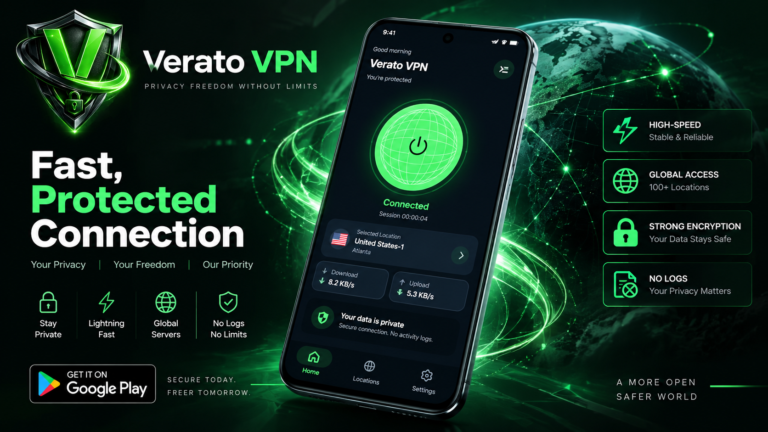
Most commercial VPN products are marketed with vague promises of “military-grade encryption” and “total anonymity.” Behind that marketing, however, running a reliable consumer VPN is a rigorous systems engineering problem: low-level network interface management, kernel-level packet routing, battery optimization on mobile clients, and multi-region gateway orchestration.
When Verato Group set out to build Verato VPN — our native Android application now live on Google Play — we established three core technical requirements from day one:
- Instant connection: Sub-second cryptographic handshakes without sluggish negotiation protocols.
- Zero operational tracking: Ephemeral key generation on-device, zero account credentials, and zero activity logging.
- Durable architecture: A globally distributed server mesh that self-heals, balances bandwidth, and prevents DNS leaks even during harsh network switching (Wi-Fi to 5G).
Here is an in-depth look at the architecture, engineering tradeoffs, and infrastructure decisions behind the platform.
1. Why WireGuard Over OpenVPN and IPsec
Legacy VPN platforms predominantly rely on OpenVPN or IPsec. While time-tested, OpenVPN carries substantial overhead: over 100,000 lines of legacy code, complex multi-step TLS handshakes, user-space context switching that drains mobile batteries, and brittle reconnections whenever a phone switches cell towers or Wi-Fi networks.
We built Verato VPN exclusively on WireGuard for clear engineering reasons:
- Lean Attack Surface: WireGuard comprises roughly 4,000 lines of code. It is mathematically auditable and drastically reduces the potential vulnerability footprint.
- Modern Cryptographic Primitives: Instead of outdated cipher suites, WireGuard relies on state-of-the-art cryptography: Noise protocol framework, Curve25519 for ECDH key exchange, ChaCha20-Poly1305 for authenticated symmetric encryption, and BLAKE2s for hashing.
- Connection Roaming: WireGuard endpoints are stateful yet connectionless. When an Android device switches from home Wi-Fi to a cellular carrier, the client doesn’t need to re-negotiate an entire TLS session. It simply sends its next authenticated packet from the new IP address, and the server seamlessly updates the roaming endpoint.
- Battery Efficiency: By avoiding continuous keepalive ping floods and heavy crypto negotiation cycles, WireGuard minimizes CPU wake-locks on mobile chipsets.
WireGuard’s simplicity isn’t just an aesthetic advantage — on mobile devices, fewer lines of code translate directly into longer battery life and zero connection drops.
2. Android Client Architecture & VpnService Lifecycle
Android provides the low-level VpnService API, which creates a virtual network interface (TUN device) on the device. All outbound IP packets matching the routing rules are intercepted by the operating system and delivered to the VPN application as raw byte streams.
Our native Kotlin client handles this lifecycle through a reactive state machine:
- JNI Bindings & Embedded Go/Native Engine: We compile the WireGuard Go implementation with cross-platform NDK optimizations to deliver high-throughput packet processing directly through Linux TUN file descriptors.
- Kill Switch & Leak Protection: To prevent data leaking during unexpected interface drops, the client binds strictly to Android’s
setUnderlyingNetworksand configures a system-level routing blackhole until the encrypted tunnel confirms its handshake. - Strict DNS Routing: DNS requests are the most frequent source of privacy degradation. Verato VPN overrides system resolvers, routing all UDP/TCP port 53 traffic directly through the encrypted WireGuard gateway tunnel to private, non-logging internal resolvers.
3. Zero-Registration Privacy by Design
True privacy cannot depend on trusting a marketing page; it must be enforced by system architecture. In Verato VPN, we eliminated the concept of user accounts entirely:
- Client-Side Key Generation: The public/private Curve25519 keypair is generated directly inside the Android Keystore on the user’s device. The private key never leaves the handset.
- Ephemeral Session Provisioning: When the user taps connect, an authenticated HTTPS API call registers the public key with the target region’s control plane for the duration of the session.
- Zero Traffic Logging: Gateway nodes run in RAM with local system logging disabled (
rsyslogdisabled, WireGuard kernel debug disabled). Packets are forwarded in memory and immediately discarded.
4. Global Infrastructure & Multi-Region Orchestration
A client application is only as fast as the network behind it. To ensure low latency and high bandwidth, we provisioned an orchestrated node mesh across key AWS regions:
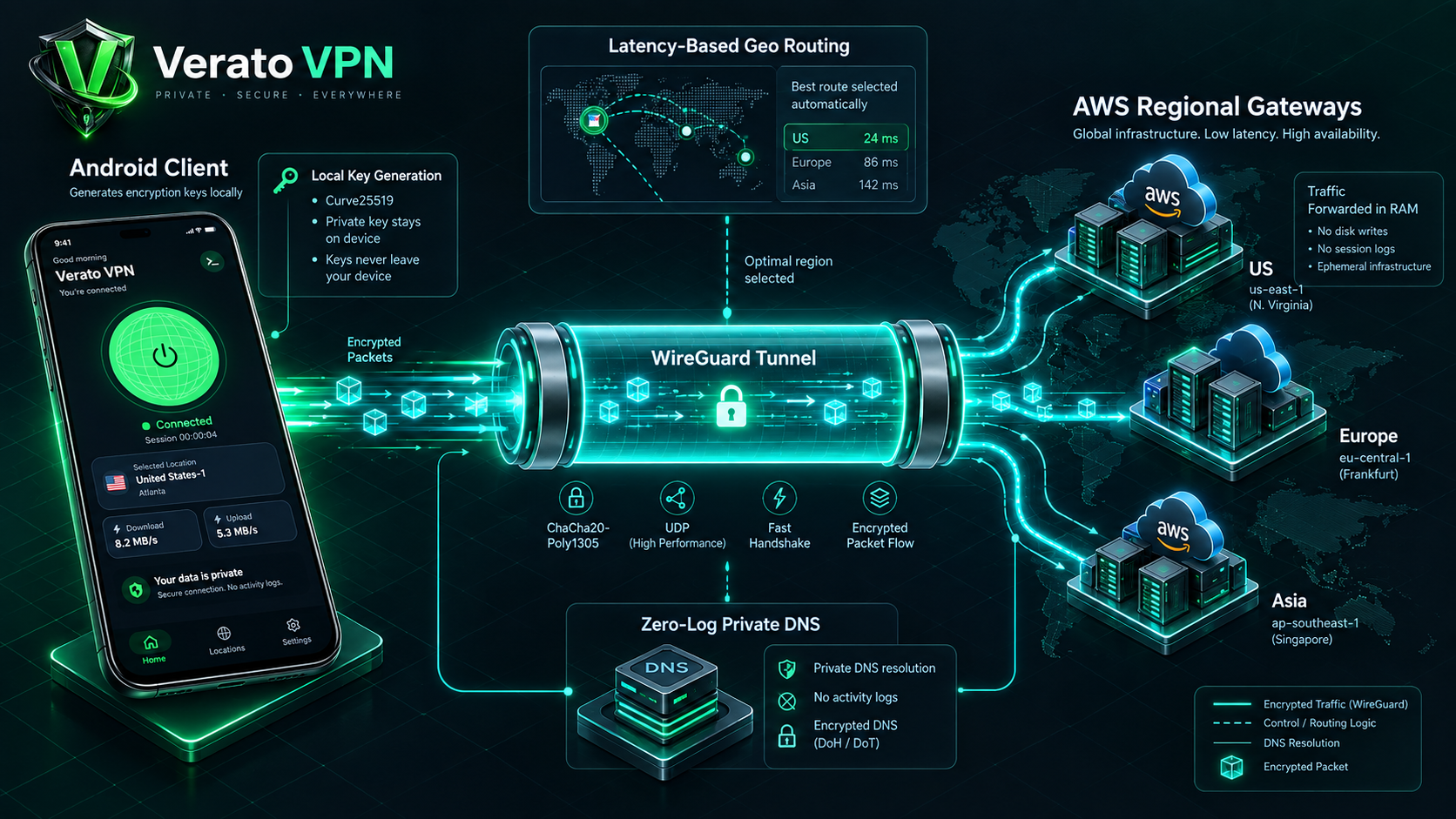
Key infrastructure elements include:
- Automated Infrastructure as Code: Node deployments, security groups, and routing tables are managed via Terraform, allowing us to spin up or tear down regional server clusters in minutes.
- Kernel Tuning for High-Throughput Routing: We optimized Linux kernel parameters on gateway instances (increasing
net.core.rmem_max,net.core.wmem_max, TCP BBR congestion control, and enabling multiqueue NIC packet steering) to eliminate throughput bottlenecks under peak loads. - Health Probes & Geo-Routing: Control plane health checks monitor node load, packet loss, and latency every 10 seconds. When a user requests a connection, our discovery API routes them to the nearest healthy node with the lowest round-trip latency.
5. Observability Without Surveillance
One of the biggest challenges in running a privacy-first platform is maintaining observability without recording user activity. You need to know if a server is degraded without inspecting who is using it.
We solved this by instrumenting system-level Prometheus metrics exporters that measure aggregate throughput, CPU utilization, interface packet error rates, and total active tunnel counts — without recording source IP addresses or destination traffic. Grafana dashboards alert our on-call team instantly if gateway handshakes fail or packet drop rates spike.
From Architecture to Production
Verato VPN transitioned from initial architecture blueprints to a hardened, published application on Google Play within a disciplined development cycle. It showcases the same engineering principles we bring to every Verato Group consulting engagement: clean boundaries, robust modern tech stacks, and systems designed for long-term operational ownership.
To explore the product milestones and live store metrics, review our full Verato VPN Case Study or test the live app directly on Google Play.
Have a mobile product, network engineering challenge, or secure cloud architecture to build? Start a conversation with our engineering team.