“We’ll figure out maintenance later” is how teams inherit systems nobody wants to touch. At Verato, ownership is part of the design conversation from day one — not a slide at the end of a kickoff deck.
Ownership sounds abstract until something breaks on a Friday afternoon. Then the questions become concrete: Who knows how releases work? Where does the data actually live? What happens when a vendor changes an API? If the answers depend on one person, one agency, or undocumented tribal knowledge, you don’t own the system. You’re renting confusion.
Ownership is not a handoff slide
Real ownership means your people — or a partner you choose — can reason about the system. That includes schemas, deployment paths, failure modes, and the decisions that shaped the architecture. Documentation helps. Readable code and clear boundaries help more.
We treat ownership as a design constraint, not a legal afterthought. Work-for-hire IP transfer matters, but so does whether the next engineer can ship a change without archaeology. Contracts transfer rights. Architecture transfers capability.
What we optimize for
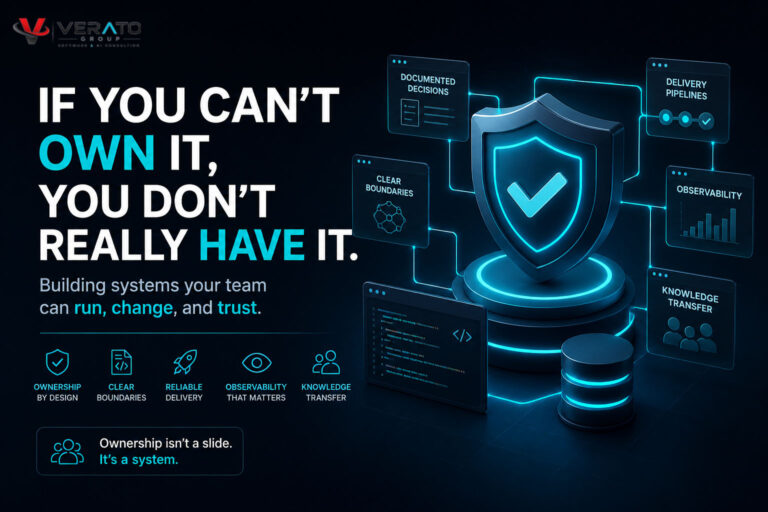
- Clear boundaries between services, data stores, and responsibilities so changes stay local.
- Delivery pipelines your team can run without calling the original builders for every release.
- Integrations that fail loudly and recover cleanly instead of silent data drift.
- Decisions written down so the next engineer is not guessing why something exists.
- Observability that makes production behavior visible before customers call.
None of these are exotic. They are the difference between a launch that ages well and a launch that becomes a liability within a year.
What we avoid
Black-box builds, mystery scripts, and “only one person understands this” setups feel fast until they aren’t. We also avoid cleverness that requires a specialist to maintain, and vendor lock-in dressed up as convenience. Short demos are cheap. Maintainable systems are the investment.
If you can’t own it, you don’t really have it — you’re renting confusion.
How ownership shows up in scoping
When we scope work, we ask who will maintain the result and design toward that answer. Sometimes that means your internal team. Sometimes it means Verato for a defined period with a planned knowledge transfer. Sometimes it means a hybrid: we build the foundation; your team owns the product surface.
We also ask what you want to be independent of. If you need to replace a CRM later, the integration layer should not assume that CRM is permanent. If compliance requirements will tighten, audit trails and access controls should not be bolted on after the fact.
A practical checklist
Before you sign a build, ask for answers to these questions in writing:
- Who deploys to production, and how?
- Where are credentials, secrets, and environment configs stored?
- What happens when a third-party API rate-limits or changes shape?
- How is the system monitored, and who gets alerted?
- What would it take for a new senior engineer to be productive in 30 days?
If the vendor cannot answer clearly, treat that as a signal — not a negotiation detail to ignore.
When we scope engagements at Verato, ownership is on the table with outcomes and constraints. If that is the conversation you need, reach out and we will walk through it with clear next steps.